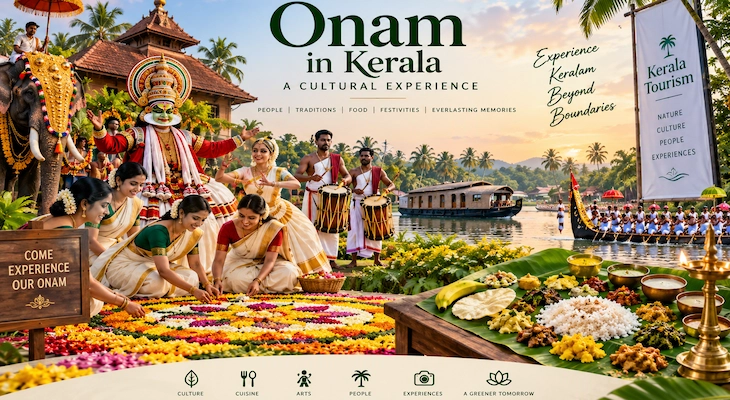
Kerala Tourism Reimagines Onam as a Major Experiential Tourism Celebration
Onam has always been much more than a festival in Kerala. It is a celebration of food, family, traditions, flowers, music, dance, games, hospitality and the cultural identity of Keralam. Now, Kerala Tourism is taking that rich heritage a step further by presenting Onam as an immersive tourism experience for visitors from India and around the world.
The recently concluded Onam Tourism Week 2026, held from August 24 to 30, showcased a new approach to festival tourism. Instead of limiting the celebrations to traditional stage programmes and public festivities, Kerala Tourism brought together cultural performances, culinary experiences, exhibitions, interactive activities, traditional arts and future-oriented attractions.
The result was an ambitious attempt to demonstrate how one of Kerala's most important festivals can become a compelling reason for travellers to visit the state.
For a destination already recognised internationally for its backwaters, beaches, Ayurveda, wildlife and hill stations, the approach adds another powerful dimension: experiencing the living culture of Kerala rather than simply sightseeing.
From Watching Kerala to Experiencing Keralam
Tourism is changing. Travellers today increasingly want to participate in the places they visit. They want to taste local food, meet communities, learn traditional skills, participate in festivals and understand the culture behind a destination.
Kerala is particularly well placed to benefit from this trend. The state has a remarkable collection of living traditions, performing arts, cuisine, festivals, handicrafts and community celebrations. Onam brings many of these elements together in one festival.
Kerala Tourism's 2026 initiative reflects this changing approach to tourism. The emphasis was increasingly on participation rather than observation.
Visitors could experience elements of Malayali life through activities associated with Onam, including flower decorations, traditional food, cultural performances and demonstrations of indigenous art forms.
The idea can be summed up as moving from “seeing Keralam” to “experiencing Keralam”. That change could have important implications for the future of Kerala tourism.
Onam Tourism Week 2026: More Than a Festival
The week-long celebrations transformed Thiruvananthapuram into a large cultural tourism platform. Events were organised at different venues, with Kanakakkunnu Palace serving as one of the major centres of activity. The programme brought together different elements of Kerala's cultural and tourism identity through dedicated spaces for business, future technologies, art and culture, and food.
The Future Zone was particularly interesting because it introduced a contemporary element into a festival deeply rooted in tradition. The combination demonstrated that cultural tourism does not necessarily mean looking only towards the past. Traditional celebrations can also incorporate innovation, technology and new forms of visitor engagement.
For Kerala Tourism, this creates an opportunity to appeal simultaneously to visitors interested in heritage and younger travellers looking for interactive experiences.
Traditional Arts Become Tourism Experiences
Kerala's performing arts are among its most distinctive cultural assets. During Onam Tourism Week, visitors were given opportunities to encounter traditional art forms including Mudiyettu, Tholpavakoothu, Padayani, Arjunanritham and Poothanum Thirayum, along with other performances.
These are not simply entertainment programmes. They represent centuries of cultural traditions, storytelling and community practices. Presenting them within a tourism framework can help introduce these traditions to visitors who may never otherwise encounter them.
For international travellers in particular, witnessing a traditional performance can provide a much deeper understanding of Kerala than a conventional sightseeing tour. It also creates an opportunity for traditional artists and cultural practitioners to reach new audiences.
The Onam Sadya: Kerala's Culinary Tourism Opportunity
Food is one of the most powerful ways to experience a culture. Onam offers Kerala an exceptional culinary tourism opportunity through the Onam Sadya, the elaborate vegetarian feast traditionally served on banana leaves.
Rice, curries, vegetables, pickles, chutneys, payasam and numerous accompaniments come together to create one of Kerala's most distinctive food experiences.
During Onam Tourism Week, food became a major part of the visitor experience, with food festivals and payasam-related activities helping to highlight the state's culinary traditions.
This approach reflects the growing importance of food tourism in Kerala. A traveller may forget the name of a viewpoint, but a traditional meal shared during a festival can become one of the strongest memories of a journey.
Kerala has enormous potential to develop this further through culinary trails, cooking demonstrations, traditional food workshops, local markets and community-based dining experiences.
“Be a Malayali for a Day”
One of the most interesting concepts associated with Kerala's experiential tourism approach is “Be a Malayali for a Day”.
The idea is simple but powerful: instead of merely watching Malayali traditions, visitors are encouraged to experience them.
Creating a pookalam, participating in traditional activities, tasting local food or learning about Kerala's arts can transform a visitor from a spectator into a participant.
This is particularly relevant to international tourism. Many travellers today are searching for experiences that feel personal and authentic. A photograph of a festival is one thing; participating in the preparation of a pookalam or sharing a traditional Sadya is something entirely different.
Such experiences can also become highly shareable content for visitors, potentially helping Kerala reach new audiences through social media and travel storytelling.
Pookalam: A Simple Tradition with Tourism Potential
The colourful pookalam, or floral decoration created during Onam, is one of the most recognisable symbols of the festival. From a tourism perspective, it offers an excellent example of how an everyday cultural tradition can become an interactive experience.
Visitors can learn about the significance of Onam, understand the flowers traditionally used, observe how designs are created and even participate in making them.
This type of activity is inexpensive, accessible and highly visual. It can be incorporated into hotels, resorts, homestays, cultural centres and village tourism programmes across Kerala.
The pookalam therefore demonstrates how experiential tourism does not always require expensive infrastructure. Sometimes, a simple cultural tradition can become an unforgettable visitor experience.
The Grand Onam Pageantry
The culmination of the celebrations was the grand Onam pageantry in Thiruvananthapuram. The procession brought together government departments, cultural groups and traditional performers in a spectacular display of Kerala's heritage.
According to the Kerala government's Information and Public Relations Department, the pageantry featured floats from 69 government departments and more than 100 traditional and folk art forms.
The scale of the event demonstrated the extraordinary variety of Kerala's cultural landscape. Traditional art forms, music, costumes, performances and themed floats transformed the streets into a large open-air cultural showcase.
For tourism, such events can be particularly powerful because they allow visitors to encounter many aspects of Kerala's culture within a single experience.
Onam and Sustainable Tourism
Large festivals inevitably create challenges related to waste, plastic consumption, transport and crowd management.
The 2026 celebrations incorporated the Green Protocol, with Kerala Tourism working with the Suchitwa Mission and Thiruvananthapuram Corporation to encourage more responsible festival practices.
This is an important aspect of the future of festival tourism. Kerala has built a strong reputation for responsible and sustainable tourism. Large cultural events need to follow the same principles.
Reducing single-use plastic, improving waste segregation, encouraging reusable materials and creating awareness among visitors can help ensure that tourism celebrations do not place unnecessary pressure on the environment.
If successfully implemented, such practices can become part of the tourism experience itself.
Why Experiential Tourism Matters to Kerala
Kerala has a strong tourism brand, but the state operates in an increasingly competitive global market. Travellers can choose from thousands of destinations offering beaches, mountains, wellness and cultural attractions.
Kerala's competitive advantage lies partly in the fact that many of its cultural traditions are still living traditions. The state's festivals are celebrated by communities rather than staged exclusively for tourists.
- Its food traditions continue in homes and restaurants.
- Its performing arts remain active.
- Its handicrafts, rituals and local customs continue to evolve.
This provides Kerala with an opportunity to develop tourism products that are difficult for competing destinations to replicate.
Taking the Onam Model Beyond Thiruvananthapuram
The experiential tourism model demonstrated during Onam Tourism Week can potentially be extended across Kerala. Different destinations have different cultural identities and can develop their own experiences.
- Alappuzha and Kumarakom can combine Onam traditions with backwater cruises, village experiences and local cuisine.
- Kochi can connect festivals with heritage tourism, art and contemporary culture.
- Munnar can combine plantation experiences with local food and high-range traditions.
- Wayanad can develop experiences around tribal heritage, agriculture, food and nature.
- Kannur can connect visitors with Theyyam and northern Kerala's cultural traditions.
- Kovalam and Varkala can integrate cultural experiences with beach and wellness tourism.
- Idukki and Vagamon can combine nature, adventure and local cultural experiences.
Such destination-specific experiences could encourage travellers to stay longer and explore multiple parts of Kerala.
Festivals Could Become Powerful Tourism Products
Kerala has a remarkable festival calendar. Onam is perhaps the best-known, but it is only one part of the state's cultural tourism potential.
Vishu, Thrissur Pooram, boat races, Theyyam seasons, temple festivals, church festivals, mosque festivals and numerous local celebrations offer opportunities to develop tourism experiences.
The key is ensuring that tourism promotion respects the cultural significance of these events. The objective should not be to commercialise traditions indiscriminately, but to create opportunities for visitors to understand, appreciate and respectfully participate in Kerala's cultural life.
A New Generation of Kerala Travellers
Experiential tourism is particularly relevant to younger travellers. Many younger visitors are less interested in traditional package tours that simply move from one attraction to another. They want experiences they can photograph, film, share and remember.
They also increasingly value authenticity. Participating in a traditional activity, learning to prepare a local dish or meeting a community can provide a more meaningful travel experience than simply visiting a monument.
Kerala Tourism's approach to Onam recognises this changing traveller mindset.
The Global Potential of Onam
Onam has the potential to become a globally recognised cultural tourism event.
The festival already has strong connections with Malayali communities around the world. The challenge is to communicate its cultural richness to visitors who are unfamiliar with Kerala.
Experiential tourism can help achieve this.
Rather than explaining Onam only through brochures and promotional campaigns, Kerala can invite visitors to taste it, see it, hear it and participate in it.
A visitor who experiences a Sadya, watches traditional performances, learns about pookalam and participates in a cultural activity can return home with a much deeper connection to Kerala.
That is the real value of cultural tourism.
The Future of Tourism in Keralam
The 2026 Onam Tourism Week points towards a broader evolution in Kerala's tourism strategy. The future may not be about simply increasing the number of destinations on a traveller's itinerary.
It may be about increasing the quality and depth of the experiences available at each destination. Keralam has the cultural resources to do this.
- Its backwaters can become more than scenic boat rides.
- Its plantations can become immersive learning experiences.
- Its cuisine can become culinary journeys.
- Its festivals can become cultural encounters.
- Its traditional arts can become interactive experiences.
- Its villages can become gateways to authentic local life.
This approach could help Kerala move towards a tourism model based on experience, participation, sustainability and cultural connection.
Onam Offers a New Way to Experience Kerala
The most important outcome of Onam Tourism Week 2026 may not be the individual events or performances.
It may be the idea behind them. Kerala Tourism is showing how a traditional festival can become a modern tourism experience without losing its cultural identity.
For visitors, Onam can offer an opportunity to do much more than photograph a celebration. They can experience the colours, flavours, sounds and traditions that make Kerala unique.
For the tourism industry, the festival provides a model for developing new cultural products. And for Keralam itself, it offers an opportunity to share one of its most important traditions with a wider world.
Onam is no longer only something to watch. Increasingly, it is something to experience.
That could make it one of Kerala's strongest cultural tourism assets in the years ahead.